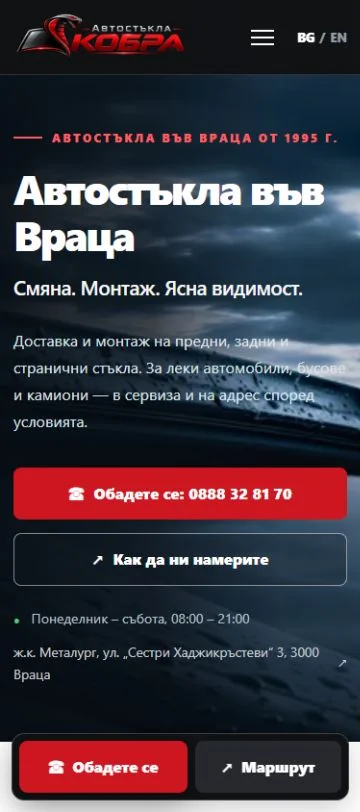
A database-free auto-glass website with bilingual homepages, service guides, call/directions tools and consent-based measurement.
avtostakla-kobra.net↗
Expand full screenshot ↓Collapse screenshot ↑
Auto Glass Kobra website — glass replacement services and contact information.
About the project
A business website for Auto Glass Kobra in Vratsa, covering windscreen replacement, side and rear glass, and mobile fitting.
Service pages, practical guidance, a work gallery and prominent contact links help visitors move from a specific problem to an inquiry.
INSIDE THE PROJECT
Features & capabilities
Explore the tools and workflows built into this project.
EXPLORE BY CATEGORY
01CAPABILITIES01 / 08
Branding and practical content
A horizontal cobra logo appears in the header/footer, alongside multi-size favicons, a 96 px browser icon, Apple touch icon and branded social image.
Responsive phone/tablet/desktop layouts use a fixed header and mobile navigation, photographed service cards and vehicle illustrations.
An eight-image gallery has descriptive captions and labels for illustrative images. A three-step service explanation and expandable FAQs help visitors understand the work.
Guides include contents lists, related links and sticky contact sidebars.
02CAPABILITIES02 / 08
Telephone contact and directions
Click-to-call links and persistent mobile Call/Directions controls provide immediate contact, with Google Maps directions, review-submission links and the Facebook profile.
Corrected map embeds show the business pin on both homepages and the contact page; maps load after consent or an explicit map-button click.
A vehicle checklist asks for make, model, year, VIN and equipment so callers can discuss the right glass, price, availability and installation date.
Business details are centrally configured. Regional service-area information keeps mobile visits conditional on confirmation.
03CAPABILITIES03 / 08
SEO, routes and redirects
Individual titles/descriptions, canonical URLs, searchable service/guide addresses, Bulgarian/English homepage hreflang, server-rendered content, headings, alt text, internal links and breadcrumbs support discovery.
A dynamic XML sitemap covers the 13 main URLs, with image references, language alternates and editorial modification dates, alongside robots.txt and Open Graph/Twitter metadata.
HTTPS/canonical-host redirects, trailing-slash normalization and legacy-homepage redirects consolidate routes. The retired repair-service URL redirects to the educational guide; a retired HTML backup returns HTTP 410.
Privacy, thank-you and error pages are marked noindex.
04CAPABILITIES04 / 08
Structured business information
AutoRepair data includes the business identity, address, phone, hours, logo, founding date, coordinates and service areas.
Website/webpage, services/catalogue, breadcrumbs and article author/publisher/date data describe the content.
About, contact, collection, advice-collection and FAQ types support the relevant pages.
05CAPABILITIES05 / 08
Consent-based analytics and advertising
Existing Google Ads configuration and its telephone-click conversion action are retained. Measurement scripts load according to consent, and hosting can override the GA4 measurement ID.
Telephone, directions and review-link events distinguish header, footer, mobile bar and content placement.
Telephone tracking measures clicks, not completed conversations. Analytics delivery still needs confirmation in GA4 after deployment.
06CAPABILITIES06 / 08
Privacy and accessible interaction
Accept/reject controls save consent, with reopenable privacy settings. Maps can load after consent or an explicit click and are removed when consent is withdrawn.
The mobile menu works by keyboard and Escape; hidden navigation is excluded from interaction.
Primary pages provide skip links, visible focus, semantic regions, labelled navigation and reduced-motion support. Content stays readable if animations fail.
07CAPABILITIES07 / 08
Performance and technical protection
WebP variants/fallbacks, responsive and preloaded high-priority hero images, lazy gallery/maps, deferred JavaScript and system fonts keep the interface lightweight.
Cache-busted CSS/JavaScript, static-asset caching and Brotli/gzip where hosting supports them aid delivery.
Shared PHP templates use centralized business configuration, output escaping and route validation, with security headers and disabled directory listings.
Development, QA, documentation and release directories are blocked from public access. No database or frontend framework is required.
08CAPABILITIES08 / 08
Development and delivery
A local PHP preview router and automated browser checks cover pages, links, metadata, images and structured-data parsing, with responsive checks at five viewport widths.
Consent, tracking, mobile-menu and redirects have dedicated checks, plus real map-rendering checks and screenshots in the project workflow.
Brand-asset generation and deployment ZIP utilities accompany publishing and Search Console indexing instructions.